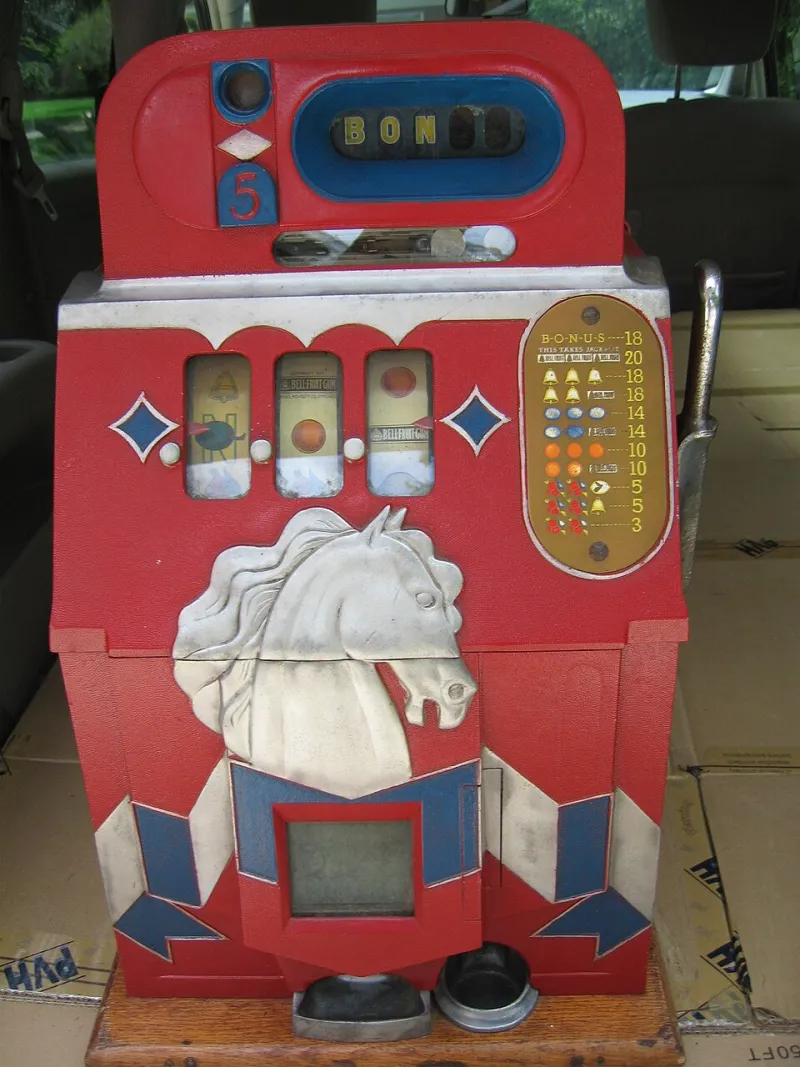
Your Mate's 'Lucky' Slot Is Lying to You — Here's the Proof
Photo: Royal Institution of Cornwall, Anna Tyacke, 2015-12-18 15:11:54, CC BY 2.0, via Wikimedia Commons
It happens every Friday night like clockwork. Your mate Dave slides off his stool, points at the corner pokie like he's found the Holy Grail, and announces with absolute confidence: "That one's been paying out all arvo. She's hot. Don't touch her."
And here's the thing — you believe him. Not because Dave has a degree in probability theory. Not because he's tracked the machine's performance across a thousand spins. You believe him because your brain desperately wants there to be a pattern. Because patterns mean control, and control means winning.
Welcome to the myth of the hot machine. It's one of the most persistent pieces of gaming folklore in Australia, and it's costing players real money every single day.
What's Actually Happening Inside the Machine
Let's start with the basics, because understanding this properly changes everything about how you play.
Every slot — whether it's a physical pokie at your local or a digital title on HellSpin — runs on something called a Random Number Generator, or RNG. This is a piece of software that produces thousands of random number sequences every single second, regardless of whether anyone is playing. When you hit spin, the RNG freezes on a number at that exact millisecond, and that number determines your outcome.
Here's what that means in practice: the machine has absolutely zero memory. It doesn't know it just paid out three times in a row. It doesn't know it's been cold for an hour. Every single spin is a completely independent event, mathematically unconnected to every spin before it.
That corner pokie Dave was raving about? It has no idea it's been 'hot.' It's just doing maths.
The RTP Number Everyone Ignores
Slots come with an RTP — Return to Player — percentage. On HellSpin, you'll find titles ranging from around 94% up to 97% or higher on certain games. What this number actually tells you is the theoretical return across millions of spins over the game's entire lifetime.
A 96% RTP doesn't mean you'll get back 96 cents for every dollar in your next session. It means that if you aggregated every spin ever played on that title across every player on every platform, the return trends toward 96%. In your personal session of 200 spins? That number is almost meaningless. Variance swallows short-term results whole.
This is why two players can sit down at the same slot on the same day and have wildly different experiences. One walks away up fifty bucks, the other drops their whole session budget. Neither outcome tells you anything about what the machine will do next.
The Brain Science Behind the Myth
So if the maths is this clear-cut, why does the hot machine myth refuse to die? Because your brain isn't built for randomness — it's built for pattern recognition.
Humans evolved to spot patterns. Noticing that a particular plant always grew near water, or that certain clouds preceded rain, was genuinely useful for survival. The brain got very, very good at connecting dots. The problem is it never learned to turn that skill off, even when the dots are completely random.
Psychologists call this apophenia — the tendency to perceive meaningful connections between unrelated things. In a gaming context, it shows up as the gambler's fallacy: the belief that past random events influence future ones. After watching a slot pay out three times in twenty minutes, your pattern-hungry brain files that as meaningful data. It's not. It's noise.
There's also something called confirmation bias working against you. You remember the times Dave's hot tip paid off because those moments are exciting and memorable. You conveniently forget the seven times you avoided a machine because someone said it was cold, only to watch the next person sit down and win.
Variance: The Concept That Actually Matters
If you want to talk about a slot being 'hot' in any meaningful sense, variance (also called volatility) is the closest thing to a legitimate conversation.
High-variance slots pay out less frequently but hit harder when they do. Low-variance slots drip out smaller wins more regularly. Neither is objectively better — it depends entirely on your bankroll, your session goals, and honestly, your personality.
If you're a player who hates long dry spells and wants regular feedback that you're still in the game, low-to-medium variance titles are your friend. If you're willing to absorb a rough patch for the chance at a serious hit, high-variance games offer that trade-off.
This is real, actionable slots strategy. Understanding variance lets you choose games that match your risk tolerance and playing style. The hot machine myth, on the other hand, just points you at whatever Dave was playing.
How to Actually Use This Information
Knowing the RNG is random doesn't mean every slot is identical — far from it. Here's how to make smarter choices:
Check the RTP before you play. On HellSpin, game information is accessible before you commit. Higher RTP means better theoretical returns over time. It's not a guarantee, but it's a real variable, unlike machine temperature.
Match variance to your session budget. Short session with limited funds? High-variance slots might wipe you out before the big hit arrives. Longer session with more room to breathe? That's when high-variance games become interesting.
Set a session limit and respect it. This is the single biggest thing separating disciplined players from players who chase. Decide what you're comfortable losing before you spin, not after.
Ignore everyone else's machine. Seriously. Dave's hot tip is just Dave's hot tip. His last fifty spins have zero bearing on your next spin.
The Bottom Line
The hot machine myth persists because it feels true, and because admitting randomness means admitting you don't have as much control as you'd like. That's a confronting thing to sit with.
But here at HellSpin, we'd rather give you the straight story than let you waste your bankroll chasing a fantasy. The games are genuinely fun. The wins are genuinely possible. But they happen because of RTP, variance, and a bit of luck — not because you found the machine Dave was warming up.
Play smart. Pick your games with intention. And maybe let Dave have his moment without stealing his stool.